Enclosure Design
Design specifications and constraints for the Dilder 3D-printed case.
Update (2026-04-22): Active enclosure prototyping is underway for the ESP32-S3 platform. Parametric OpenSCAD parts are being iterated in
hardware-design/scad Parts/. See the Design Evolution page for the latest CAD renders, version history, and part specifications.Note: The original specs below are initial concepts based on the Pi Zero + HAT form factor. The ESP32-S3 enclosure has superseded these dimensions.
Form Factor
Style: Landscape rectangle — "iPod Nano" layout with display dominating the left face and a compact button cluster on the right.
Concept renders:
v1 — Initial rough layout

v2 — Dimension-accurate revision (current reference)
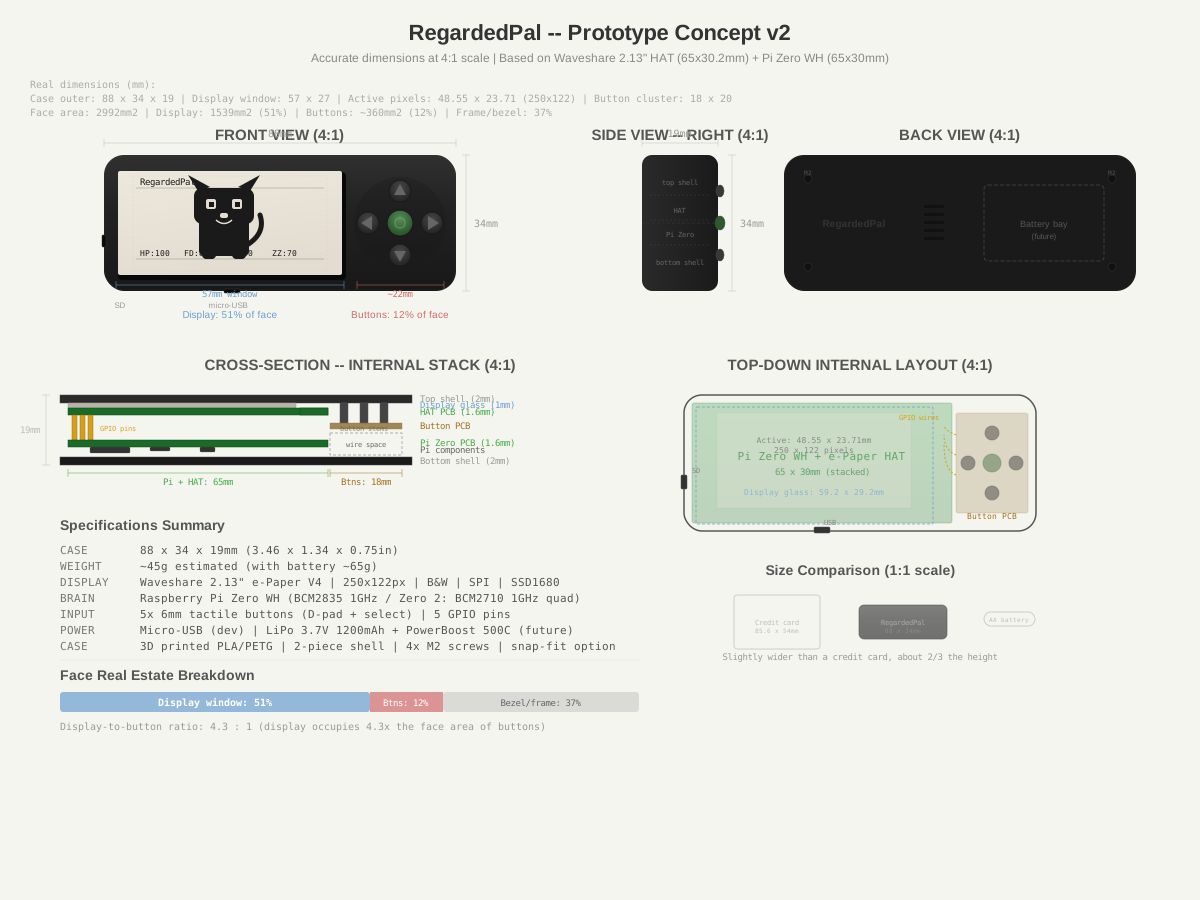
v2 Dimensions
| Metric | Value |
|---|---|
| Case outer dimensions | 88 × 34 × 19mm |
| Display window cutout | 57 × 27mm |
| Active pixel area | 48.55 × 23.71mm (250×122 px) |
| Button cluster width | ~22mm |
| Button center-to-center | ~10mm |
| Display face coverage | 51% |
| Button face coverage | 12% |
| Display-to-button ratio | 4.3 : 1 |
| Estimated weight | ~45g bare / ~65g with battery |
| Size reference | Slightly wider than a credit card, ~2/3 the height |
Component Dimensions
Sourced from official datasheets and measured hardware.
| Component | Dimension | Source |
|---|---|---|
| Pico W board | 51 × 21 × 3.9mm | Pico W datasheet |
| Pi Zero board (future) | 65 × 30 × 5mm | Official Raspberry Pi spec |
| Waveshare HAT board | 65 × 30.2mm | Waveshare specification |
| Display glass outline | 59.2 × 29.2 × 1.05mm | V3 specification PDF |
| Display active area | 48.55 × 23.71mm | V3 specification PDF |
| Dot pitch | 0.194 × 0.194mm | V3 specification PDF |
| 6×6mm tactile button | 6 × 6 × 4.3–9.5mm | Standard spec |
Pico W is smaller
The Pico W (51 × 21mm) is significantly smaller than the Pi Zero (65 × 30mm). If the final build uses the Pico W, the enclosure could be more compact — but the display board (65 × 30.2mm) is still the space-limiting factor.
Design Constraints
These constraints must be satisfied by any enclosure design:
- Display cutout: 57 × 27mm with 1mm case lip overlap around display glass
- Button holes: 5× circular apertures, ~7mm diameter, d-pad cross pattern with ~10mm center-to-center
- USB access: Micro-USB slot on edge (power and data during development)
- Assembly: 2-piece shell (top + bottom), 4× M2 corner screws
- Shell seam: Horizontal split at case midpoint
- Battery bay: Reserved space for LiPo battery (later phase)
- Ventilation: Slot vents on back panel
Material Options
| Material | Pros | Cons |
|---|---|---|
| PLA | Easy to print, good detail, cheap | Brittle, warps in heat |
| PETG | Tougher than PLA, better heat resistance | Slightly harder to print, less detail |
| ABS | Good mechanical properties | Warps badly without enclosure, fumes |
| ASA | Weather resistant, UV stable | Expensive, similar print difficulty to ABS |
Recommendation for prototype: PLA. Fast to iterate, lowest barrier to getting prints done. Switch to PETG or ASA for a final build.
3D Printing Pipeline
A full analysis of printing technologies, third-party services, CAD workflows, and cost estimates is available in the dedicated pipeline document:
3D Printing Prototyping Pipeline
Technology Summary
| Technology | Home Printer? | Service Cost (Dilder case) | Best For |
|---|---|---|---|
| FDM/FFF | Yes ($150–$1500) | $1–$5 | Cheapest rapid iteration |
| SLA/MSLA | Yes ($150–$3500) | $1–$8 | Best surface finish |
| SLS | No (service only) | $4–$25 | Strongest functional parts |
| MJF | No (service only) | $3–$20 | Best price/quality via services |
Recommended Approach
| Phase | Method | Material | Est. Cost |
|---|---|---|---|
| Fit-check prototypes | Home FDM or JLCPCB SLA | PLA / standard resin | $0.50–$15 |
| Functional prototypes | Home FDM or JLCPCB MJF | PETG / PA12 nylon | $0.65–$18 |
| Final enclosure | JLCPCB MJF | PA12 nylon (dark grey) | $8–$18 shipped |
Top Service Options
| Service | Dilder Case Price | Lead Time | Notes |
|---|---|---|---|
| JLCPCB | $3–10 + $5–10 shipping | 7–15 days | Cheapest, bundle with PCB orders |
| Craftcloud | $5–15 + varies | 3–14 days | Price-comparison marketplace |
| Xometry | $12–30 (shipping included) | 3–10 days | Fastest US option |
Combine with PCB orders
If ordering PCBs from JLCPCB, add the 3D-printed case to the same shipment to eliminate separate shipping costs. MJF PA12 nylon is the recommended material — no layer lines, strong snap-fits, dark grey finish.
Current Work (ESP32-S3 Enclosure)
Active parametric CAD development is tracked on the Design Evolution page, including:
- Standalone OpenSCAD parts with per-part version snapshots
- Middle plate (board tray) with tunable header slot dimensions
- Top cover frame with countersunk pillar pockets
- Windowed display plate with snap-fit retaining rails
- Interactive Python export tool and workflow guide
Future Revisions
- v3: Incorporate real component fits once hardware is assembled — verify display + board stack height, button stem clearance
- v4: Add lanyard loop, finalize battery bay for specific battery model
- Final: Choose between Pico W and Pi Zero form factor, finalize internal mount points